
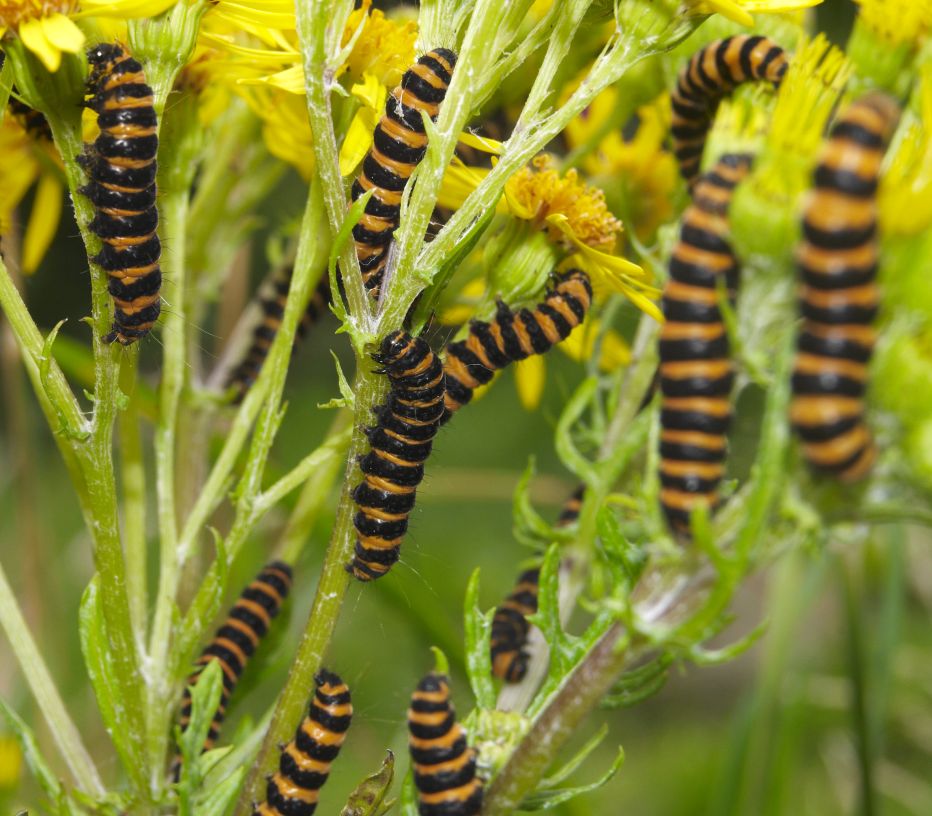
Interestingly, although many other native plants, including Daffodils and Bluebells, are potentially toxic to grazing animals, it's Ragwort that tends to get a bad name, especially amongst horse owners. Ragwort is a really valuable haven for wildlife, when allowed to grow in the right places, and, on our reserves, we only clear it when absolutely necessary.

Ragwort supports more than 40 other insect species and is an important source of nectar. It's the main foodplant for Cinnabar Moth caterpillars, a beautiful species, currently in decline.
They can be found in their hundreds munching away on yellow-flowered Ragwort, and their bold black-and-gold stripes make them easy to identify.
Ragwort is dangerous to horses and other grazing animals if eaten, but this is only likely to happen via contaminated hay. The toxins within the growing plant make it so bitter and unpalatable that horses etc steer well clear. But Cinnabar caterpillars feast upon Ragwort without ill effect. They actually benefit from its toxicity by eating enough of it to become toxic themselves, and their colourful stripes are a warning to predators: I’m poisonous and taste terrible, don’t try to eat me.

Newly-hatched caterpillars are vulnerable at first so will cluster together, starting at the base of the plant and working their way up. As they grow bigger and develop their toxic defences they start to spread out, and with hundreds of hungry mouths their host plant can be rapidly reduced to a ragged, leafless stem. Large populations can easily decimate an entire patch of Ragwort and many caterpillars will starve if their food runs out before they are fully grown, so as competition intensifies the caterpillars become more aggressive and may even turn to cannibalism in their quest for calories. It takes about a month for them to develop fully, at which point they will descend to ground level ready to pupate. They will remain here all winter, safe inside their cocoons, and complete their metamorphosis the following spring to emerge as beautiful black and red adults.
It is thanks to this vibrant red colouration that the moth earned its unusual name, inspired by the red mineral cinnabar - a toxic mercury ore that was once widely used as an artist’s pigment. The adult moths fly during the day and could easily be mistaken for exotic butterflies. They are brightly coloured for the same reason as the caterpillars, since the Ragwort’s toxins remain in their bodies and still provide an effective defence against predators.
Find out more
Read The Wildlife Trusts blog on how outdated rules on 'weeds' have led to Ragwort being demonised
Take Action for Wildlife
With so many species on the Red List and at risk of extinction, we need to do all we can to stand up for wildlife. One of the best actions you can take to help is by joining us as a member or making a donation.
This post is also available on Sussex Wildlife Trust website

