
By James Duncan
Communities and Wildlife Officer
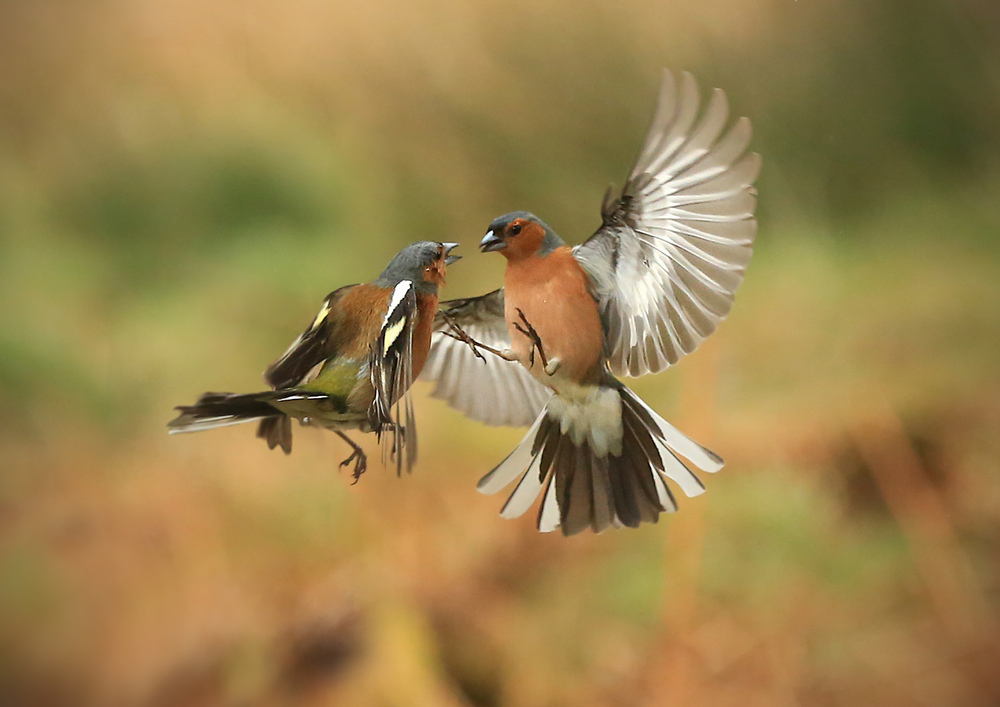
Chaffinch (Fringilla coelebs)
Let's start with the Chaffinch, our most familiar British Finch. Perhaps surprisingly it's the UK's third commonest breeding bird after Wren and Robin, estimated at more than 6 million pairs. It was originally a woodland species but has since branched out into farmland, parks, gardens, towns, pretty much anywhere in fact. There's little doubt it's a supremely adaptable bird, thriving in areas with Oak, where a plentiful supply of invertebrates are found. They are of course often seen foraging on the ground and it's always a joy to see their flashy salmon pink and blue-grey combination. Considering their abundance, there's something about the Chaffinch which is probably much overlooked - it's absolutely beautiful, though admittedly, in contrast, the female is somewhat drabber.
The Chaffinch is also responsible for the very naming of its entire family. The second half of the name is a prime example of onomatepeia. That is, they're named after the sound they make. Its striking, monosyllabic social call is really characteristic once learned and is uttered when the bird is perched - transliterated as 'pink' or 'spink.' In fact the second of these is still used as another name for the bird in parts of Northern England. This call may be uttered singly, as a double note or even extended into a short series. The word 'Finch' in fact derives from the old English, 'finc' and though the call has been somewhat lost in the English translation, it's far more apparent in Dutch (vink), German (fink) and Scandinavian (finke). As with many bird calls, it can serve a variety of purposes, including - a bird separated from its flock or mate, a bird in immediate danger, a bird wishing to rally other Chaffinches to mob an intruder and even a territorial bird behaving aggressively towards another Chaffinch.
Chaffinch vocabulary is complex and demonstrates a surprising level of sophistication. In addition to its song, it's thought to have around ten different calls. Along with the Great Tit, Chaffinch may be the other species most commonly associated with 'unidentifiable' woodland calls.
Listen to this call below -
Ultimately though it's the song that provides the Chaffinch with its cheery disposition. It's a simple, bright and loud, two or three note-rattling verse that's consistent in its delivery. It tends to begin with a few rapid sharp notes, progressively decreasing into a similar set of notes at a lower tone, prior to ending with a lovely flourish known as a cadence. If the winter is mild this song can sometimes be heard early in the year, though it seems the Chaffinch often needs a bit of practice before hitting the right notes! In their prime the birds repeat this phrase endlessly, up to six times a minute and three thousand times a day. Most famously the song has been likened to the run-up of a cricketer to the wicket. Imagine the initial trill as the running footsteps and the cadence as the bowling action. Chaffinches are also well known for a propensity for regional variation - the song alters across both counties and countries, though typically just the structure of the final cadence. This fact is even demonstrated in writings as far back as the 17th century. In days gone by birds from Essex were known as 'chuckwados' and birds from Kent as 'kiss-me-dears.'
Listen to the song in this video -
The Chaffinch is also known for having a so-called 'rain-song.' It has been considered to predict impending rain, though you may not want to use it as an alternative to the weather forecast. It's certainly not the most melodic part of their repertoire and is typically heard as a territorial call within the breeding season, though occasionally as an alarm. It has a distinct 'rolling' quality, albeit very rapid in delivery. As with the song this call is subject to an extensive variety of regional dialects, particularly between the Northern and Southern extent of its breeding distribution, though this may be complicated further by the variety of Chaffinch subspecies found across Europe.
Listen to this call below -
Of the many calls exhibited by the Chaffinch, another of the more common is a forceful, upwards-inflected piping whistle. It may be repeated tirelessly (much like the call above) and sits somewhere between the call of both Chiffchaff and Willow Warbler, though it's usually significantly louder. It may be transliterated as an insistent "hueet." Once again it's worth noting this call is subject to significant geographical variation, often heard without the up-slurring, reinforcing the complexity of their vocalisations.
Listen to this call below -
In contrast to the bolder, more forthright calls, the flight call of the Chaffinch is rather unobtrusive and gentle. It's a softly spoken "yupp, yup, yup" that's uttered by individuals and migrant flocks, particularly as a means of flock coordination. It may also be heard from a bird intending to take flight. Though surprisingly subtle, it's this very quality that makes it recognisable. It's lower and weaker than the harder-edged Greenfinch flight calls and the notes don't have the 'bounce' that's characteristic of both Linnet and Goldfinch.
Listen to this call below -
This post is also available on Sussex Wildlife Trust website

